"Both in store and mobile TIRE services for passenger & light trucks."
CAN FLAT TIRES BE REPAIRED?
"Guidelines allow the repair of punctures in a tire's tread area of up to 1/4" in diameter"
While almost any sharp object left on the road can cause a puncture, most are caused by small nails and screws (typically less than 1/4" in diameter).
Guidelines allow the repair of punctures in a tire's tread area of up to 1/4" in diameter. Repair of larger tread punctures and of punctures to the tire's shoulder and sidewall areas are not recommended.
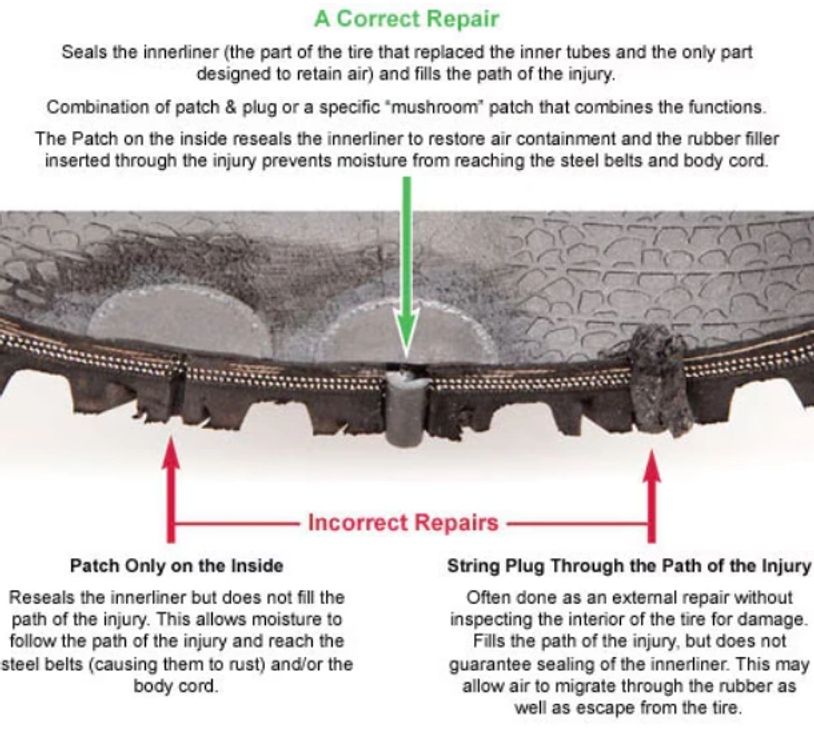
There are three primary considerations when repairing a punctured tire. You need to evaluate the damage the object caused as it punctured the tire, reestablish an airtight seal of the tire's innerliner, and completely fill the path the object took through the tire. Typically a mushroom-shaped patch and plug combination repair is considered to be the best method of repairing a punctured steel belted radial.
Any repair attempted without removing the tire from the wheel is improper. Without inspecting the inside of the tire for hidden damage comes the risk of returning a weakened tire to service. Punctures in the tread area that looked repairable have revealed upon further investigation that the object that punctured the tire had been long enough to cut the tire's sidewall from the inside. Without dismounting the tire, the hidden damage would have been missed.
Simply plugging a tire from the outside without removing the tire from the wheel is improper. (If a tire is punctured while off-roading far away from civilization and a spare tire isn't available, a plug may serve as a temporary low speed solution that must be replaced with a proper repair as soon as possible upon returning to the road.)
Additionally, any repair that doesn't completely fill the path the object took through the tire is incomplete. While a patch on the inside of the tire reseals the innerliner, it does not fill the path of the puncture. This will allow moisture to reach the steel belts and/or the casing cords causing them to rust or deteriorate.
There are many different rubber compounds used in a tire. The tire's innerliner uses a special rubber compound that has the ability to better retain air. Once punctured, the innerliner must be cleaned, buffed, cemented, patched and coated to assure its ability to retain air has been restored. Since this can only be done from inside the tire, it's another reason that a plug-only repair is improper.
Continuing to drive on a tire with a slow leak may allow moisture to seep around the object and into the tire. This will reduce the probability that the tire can be repaired properly because the moisture will ultimately reach the internal steel and fabric cords used to reinforce the tire and possibly cause rust and loss of strength. To assure reestablishing a watertight seal the injury must be cleaned with a specially designed cutting drill that removes rust and sizes the injury properly to accept the rubber stem of the patch. Cemented in place, the stem will vulcanize with the tire to help prevent moisture from reaching the tire's reinforcing cords from the outside.
While indoor laboratory tests have shown that freshly punctured and properly repaired speed rated tires can still achieve high speeds, it is not recommended that repaired street tires, or punctured DOT-legal competition tires and racing slicks be used for track events.
How do you know which procedures a tire dealer uses? Ask them! But be aware that if they say they can repair a tire in 10 minutes for under $10 without removing it from the wheel, they aren't following the Rubber Manufacturer's Association procedures. A correctly done flat repair that follows the multi-step repair procedures will take approximately 30 minutes and probably cost around $30. Driving on an improperly repaired tire is dangerous because it can further damage the tire and/or allow its strength to deteriorate over time. An improperly repaired tire driven at high speeds may suddenly fail, causing loss of vehicle control. Additionally, the use of an innertube as a substitute for a proper repair generates additional heat and should not be considered.
CAN DAMAGED TIRES BE REPAIRED?

While the rubber doesn't appear to have been severely damaged driving this tire for one mile when flat, the exterior abrasions confirm the sidewalls scuffed across the pavement due to the absence of air pressure allowing the tire's reinforcing cords to fold under the weight of the vehicle .
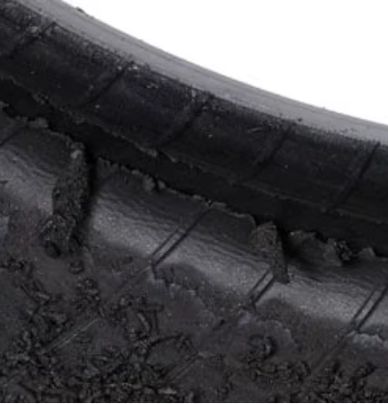
Viewing the interior of the same tire reveals its innerliner has been destroyed and reinforcing cords have most likely been permanently weakened. The interior sidewall chafing against itself has caused the rubber to crumble into loose fragments. This tire must be replaced.

This tire has been punctured in the tread area by a screw less than 1/4" in diameter. If no internal damage is found when the tire is dismounted, this puncture can be repaired following industry guidelines and the tire returned to service.
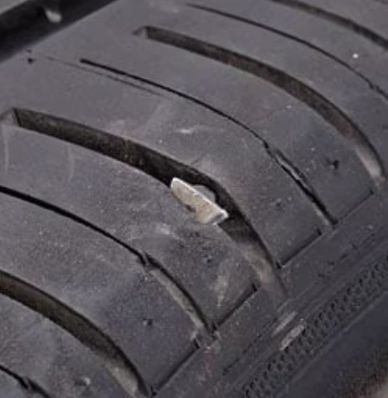
This tire has been punctured through the shoulder area long enough ago for part of the nail head to have worn away. Since the puncture is outside the permitted repair area, this tire must be replaced.
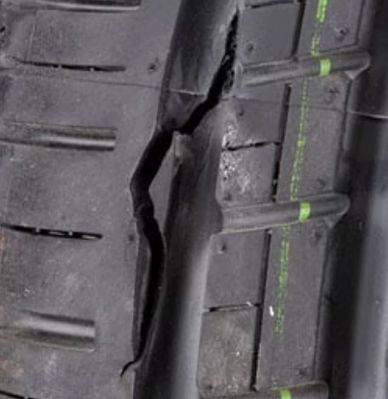
While this tire had only been in service for 24 hours, it ran over some accident debris that sliced through the tread, steel belts and body plies in an instant. The size of the jagged cut prevented repair to even be considered.
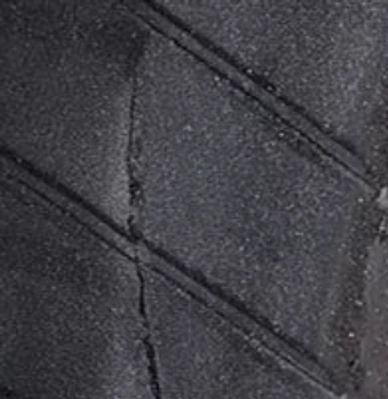
The interior inspection confirms the extent of the damage. The long cut would prevent the steel belts from providing the strength and durability needed for continued safe operation. This tire is beyond repair and must be replaced.